

Gaza Crisis Relief: Help Children in Urgent Need
Children in Gaza are continuing to suffer extreme deprivation, hunger, injury and death due to the ongoing conflict and aid obstructions. Families are experiencing severe malnutrition and preventable deaths every day because many cannot reliably access basic food or services.[1]
Save the Children's commitment to children remains unwavering, and we are ensuring our life-saving work in Gaza and the West Bank continues through local staff and partners.
Save the Children's Humanitarian Response in Gaza
Amidst extremely challenging conditions, our team in Gaza have been working tirelessly to find ways to deliver aid to children. Here's a snapshot of just some of what our teams have been able to accomplish since the beginning of this crisis:

Roof SVG for web use
Delivered essential items, like tents, bedding, warm clothes and basic cooking items, to families who’ve lost everything

Water icon
Provided fuel and water infrastructure for hospitals and distributing water storage tanks

Delivered mental health and psychosocial support services for children and caregivers, including setting up Child-Friendly Spaces

Identified the most at-risk children for child protection services
Has the UN concluded that genocide is occurring in Gaza?
Yes. A UN commission concluded, for the first time, that genocide is being committed in Gaza.
Below is an excerpt from a statement from leaders of over 20 major aid agencies working in Gaza.
"What we are witnessing in Gaza is not only an unprecedented humanitarian catastrophe, but what the UN Commission of Inquiry has now concluded is a genocide. With this finding, the Commission joins a growing number of human rights organizations and leaders globally, and within Israel.
The inhumanity of the situation in Gaza is unconscionable. As humanitarian leaders, we have borne direct witness to the horrifying deaths and suffering of the people of Gaza. Our warnings have gone unheeded and thousands more lives are still at stake."
Now, as the Israeli government has ordered the mass displacement of Gaza City – home to nearly one million people – we are on the precipice of an even deadlier period in Gaza’s story if action is not taken. Gaza has been deliberately made uninhabitable.
What is the current humanitarian situation in Gaza?
The situation in Gaza is catastrophic. Children are literally starving. Markets are empty, food is unavailable, and malnutrition is widespread — not only among children, but also among pregnant women, breastfeeding mothers, and the broader adult population.
As our Gaza Humanitarian Director, Rachael Cummings, described to journalist Jonathan Karl on ABC News’ This Week on Sunday, July 27:
“Every child in the health center today was malnourished, but also every adult was extremely thin, gaunt-looking, exhausted. The situation is absolutely terrible here.”
Save the Children teams are seeing a sharp rise in malnourished children at our clinics — and the numbers continue to grow.
Despite these incredibly challenging conditions, our teams are working tirelessly to deliver critical aid to children and families. We're reaching 26 communities daily with clean drinking water, screening and treating children for acute malnutrition, and supporting mothers with nutritional care — even as access remains dangerously restricted.
Why is Save the Children saying a ceasefire is critical?
Only a definitive ceasefire can allow aid to reach children consistently and safely. A pause that can be lifted at any moment risks reimposing siege conditions that make starvation worse.
“So long as it is not definitive, any pause offers the people of Gaza a glimmer of hope just to replace it with further horrors.” – Ahmad Alhendawi
We have life-saving supplies ready in Jordan, the West Bank, and Egypt. But without guarantees of safety and access, we cannot reach the families who need them most.
Until then, we are doing everything in our power to reach families inside Gaza with services at our health clinics, malnutrition screening and treatment, and water trucking.
Can malnutrition in children in Gaza really be reversed?
Malnutrition is preventable, and it is treatable. We know how to save children’s lives. But that requires sustained access to:
- Nutritious food
- Medical care
- Specialized supplements
Unfortunately, severe acute malnutrition is a life-threatening condition, in which children’s bodies are so malnourished they are experiencing wasting. With timely intervention, children’s bodies can stabilize. This requires medical care and fortified foods. Without quick and sufficient treatment, severe acute malnutrition can result in permanent developmental harm to a child and even death.
A few days of aid cannot undo months of starvation for 1 million children. They need sustained support at scale to recover and survive.
Our two primary health care centers in Deir al-Balah and Khan Younis are providing critical maternal, newborn, and child care — screening children and mothers for malnutrition, offering nutritional support, and delivering essential medical services every day.
What is Save the Children doing to help children in Gaza?
Here’s what we’re actively doing on the ground:
WATER, SHELTER, AND ESSENTIAL ITEMS
- Providing clean drinking water in 26 communities daily
HEALTH & NUTRITION
- Operating two primary healthcare centers
- Treating malnutrition and supporting mothers and newborns
- Running mother/baby areas for nutritional support
EDUCATION
- Running temporary learning spaces for children aged 3–12
- Supporting children who can no longer access formal schooling
"We will do everything we can to ensure the aid entering reaches and saves the lives of children and families. But a temporary pause is simply not enough.”
What is the scale of suffering for children and families in Gaza right now?
The scale of suffering is staggering. According to Rachael Cummings:
“Mothers went from eating three meals a day to two, to one. Now, they’re not having a meal a day. And this is very, very concerning. And this is at scale.”
This isn’t a future threat — it’s the current reality for hundreds of thousands of families. Children are losing hope. One aid worker shared:
"Children tell their parents they want to go to heaven, because at least heaven has food."
How can I help children in crisis in Gaza?
Your support can save lives. Donations help us:
- Deliver food and medical care to malnourished children
- Keep our clinics open and staff on the ground
- Mobilize emergency supplies already staged near Gaza
- Continue advocating for a permanent ceasefire and safe humanitarian access
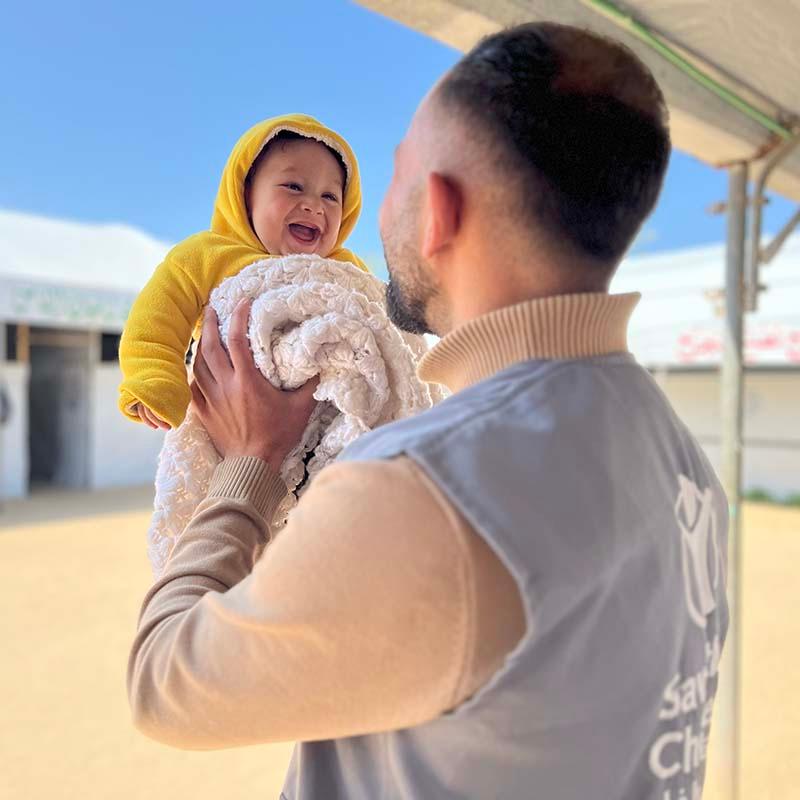
In Gaza, an aid worker holds a smiling baby in his arms nearby a Save the Children clinic for nutrition services and safe spaces for pregnant and breastfeeding mothers of infants and young children.
Over the past two years, living and working as a humanitarian in Gaza has been personally painful and professionally brutal. I have witnessed children and families visiting Save the Children clinics and services, hungry, injured and emotionally scarred, bearing the wounds of the war on their eyes, bodies and souls.
In this war, I lost my home and my brother, who was a father to five children. He was killed in an Israeli airstrike and bled to death because emergency medical help could not reach him. Since then, I have become a father, mother, friend and guardian to my nieces and nephews.
Each day, we witness the resilience of families grappling with trauma and deprivation. Together, we deliver life-saving health and nutrition services, offering hope and healing to Gaza’s most vulnerable. To continue doing that we need aid f low to be at the scale and at the pace that fits the growing needs.
- Mervat Ouda Hijazi, Health & Nutrition Advisor, Save the Children

Save the Children has a proven track record of using donations efficiently and effectively to change children's lives. We are proud to have received an A- rating from CharityWatch and a 4-star rating from Charity Navigator, the highest score possible from America’s leading independent charity evaluator.
This recognition reflects our long-standing commitment to ethical governance, transparent operations, and fiscally responsible use of donor support.
Updated: April 2026